Using AI to improve business efficiency means connecting AI agents to the email, WeChat, Lark, Teams, Xero and ERP a business already runs, so the agents take over receiving, recognising, transcribing, checking, reminding and writing back, while people keep approval, payment and external commitments. In BEE Sigma’s 2026 project records, time to first result for one workflow ranged from 11 days to 3 months: sales reconciliation live in 11 days, site timesheets in company-wide use after 10 weeks, a first production cross-border order after 90 days, and supplier invoices reaching 91.48% automatic routing in one accounting month after three months (project review of 1 September 2026, not confirmed in writing by the client). The five levers follow.
First answer: where efficiency comes from, and where it does not
Efficiency does not come from a stronger model. It comes from one less transcription, one less wait, one less question. Reviewing our 2026 records, every workflow that paid back quickly had the same shape: frequent, rules that can be written down, data already in some system, and errors that a person catches at the next step. Three kinds of work should not go first: infrequent high-judgement decisions, actions where a mistake is costly and nothing catches it, and processes whose data still lives in someone’s head. Draw that line first, then choose the workflow.
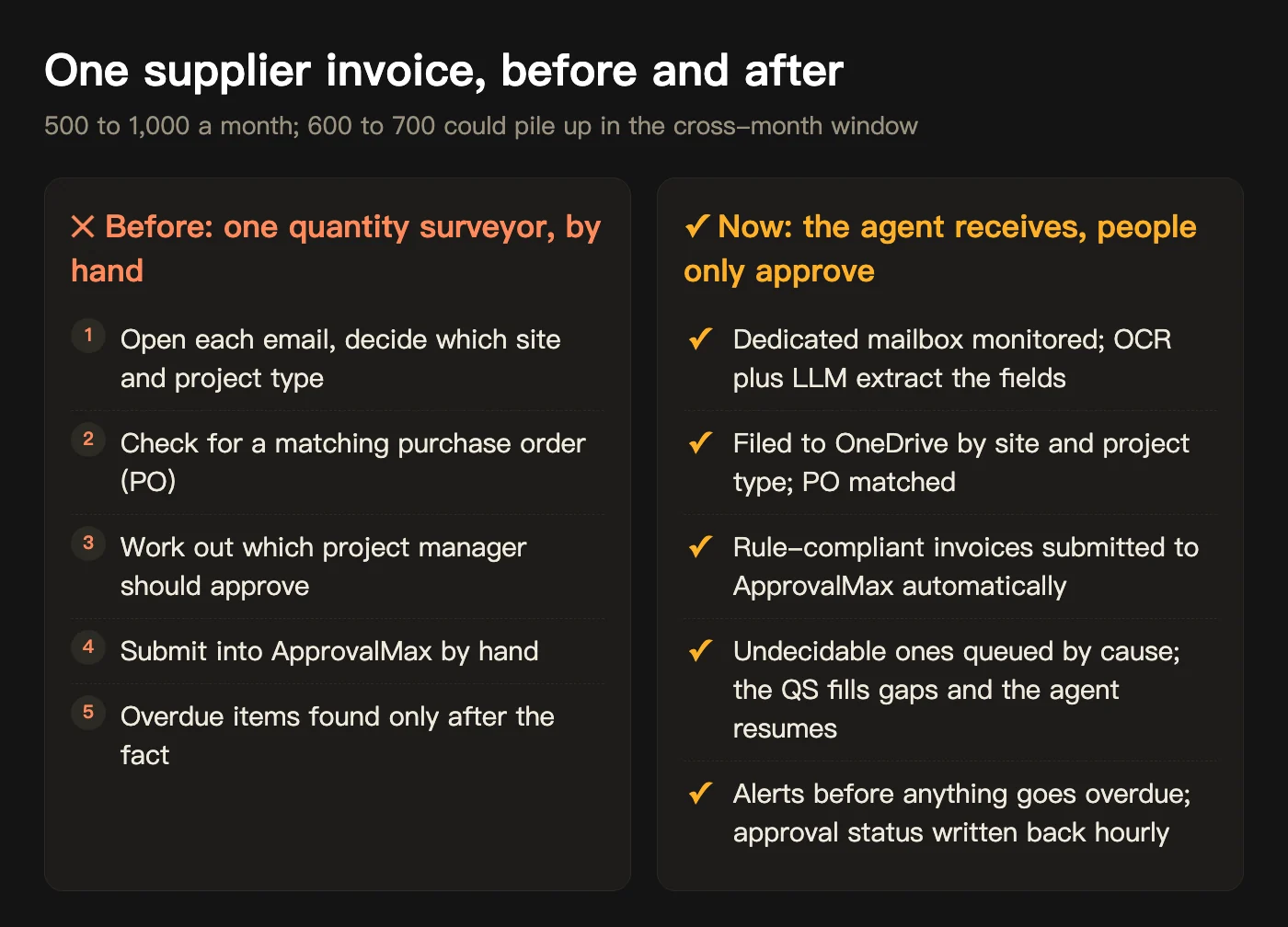
Lever one: document routing, so people only see the 9% that needs judgement
A New Zealand construction head contractor receives 500 to 1,000 supplier invoices a month, formerly recognised, filed, matched to purchase orders and submitted for approval by one quantity surveyor. The agent was connected in June 2026, ran real invoices in July and was calibrated at full volume in August. In the client’s accounting month (26 July to 25 August), 730 of 798 invoice documents were routed automatically and 68 went into a manual queue sorted by cause: 91.48% (project review of 1 September 2026). The agent receives, recognises, files, matches and submits; people handle the invoices the agent cannot decide, approve in ApprovalMax, and pay and lock the month in Xero.
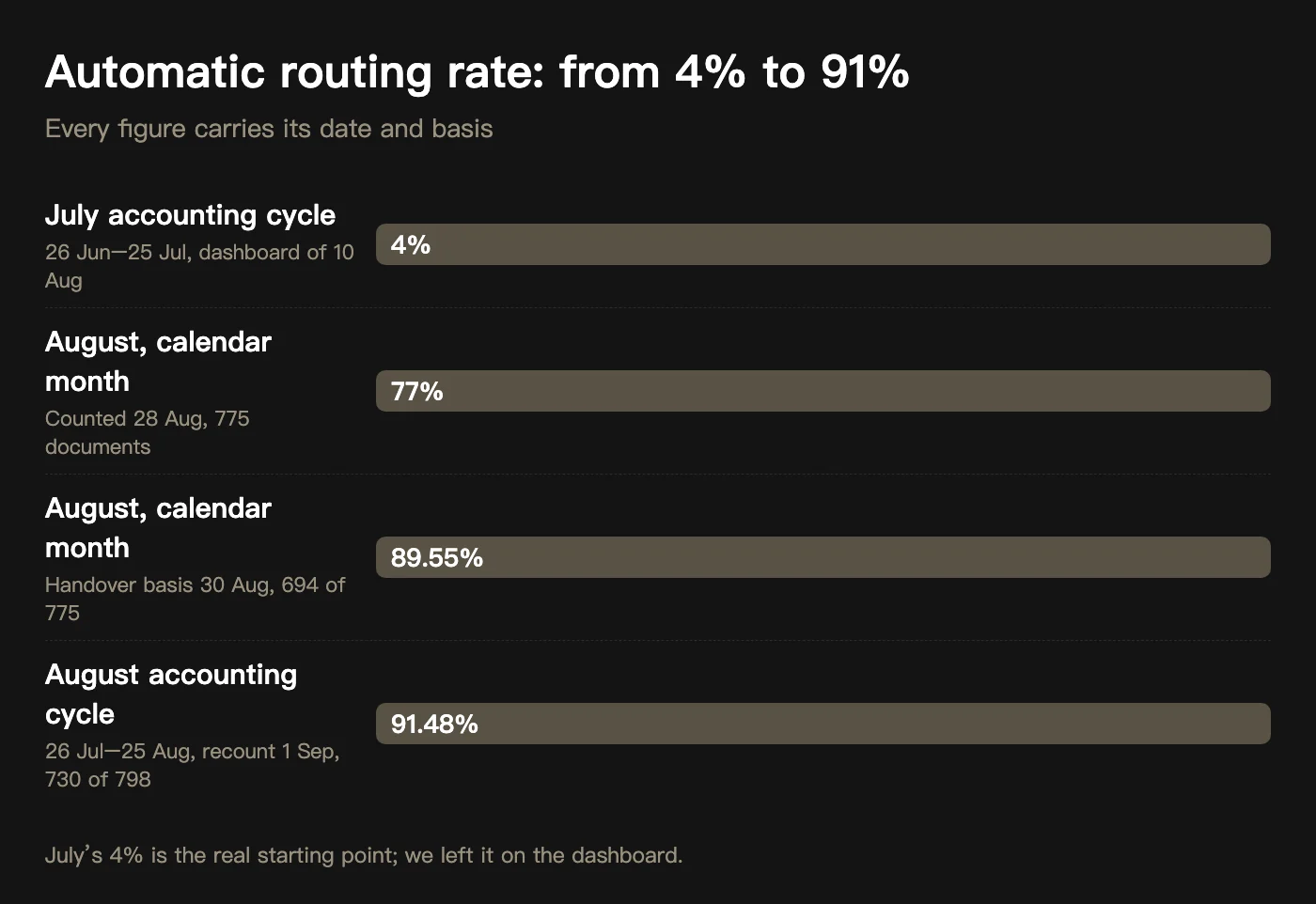
Lever two: field data entry, turning one sentence into one record
A South Island construction company with a few dozen workers across nearly twenty projects recorded hours from foremen’s memory after work, then totalled them in Excel. Kickoff was 8 April 2026, the first workflow ran end to end on 7 May and the whole company was using it by 15 June, about 10 weeks. Now a foreman says one sentence in a Lark group, the agent parses it into the daily hours detail and site diary, and pay-rate matching runs as a Base automation, not through a language model. The quarterly report of 27 June showed 20 projects, 334 daily records and more than 10,000 hours in the system. The key was not recognition but the entry point: no new app, no company account, just the group workers already used.
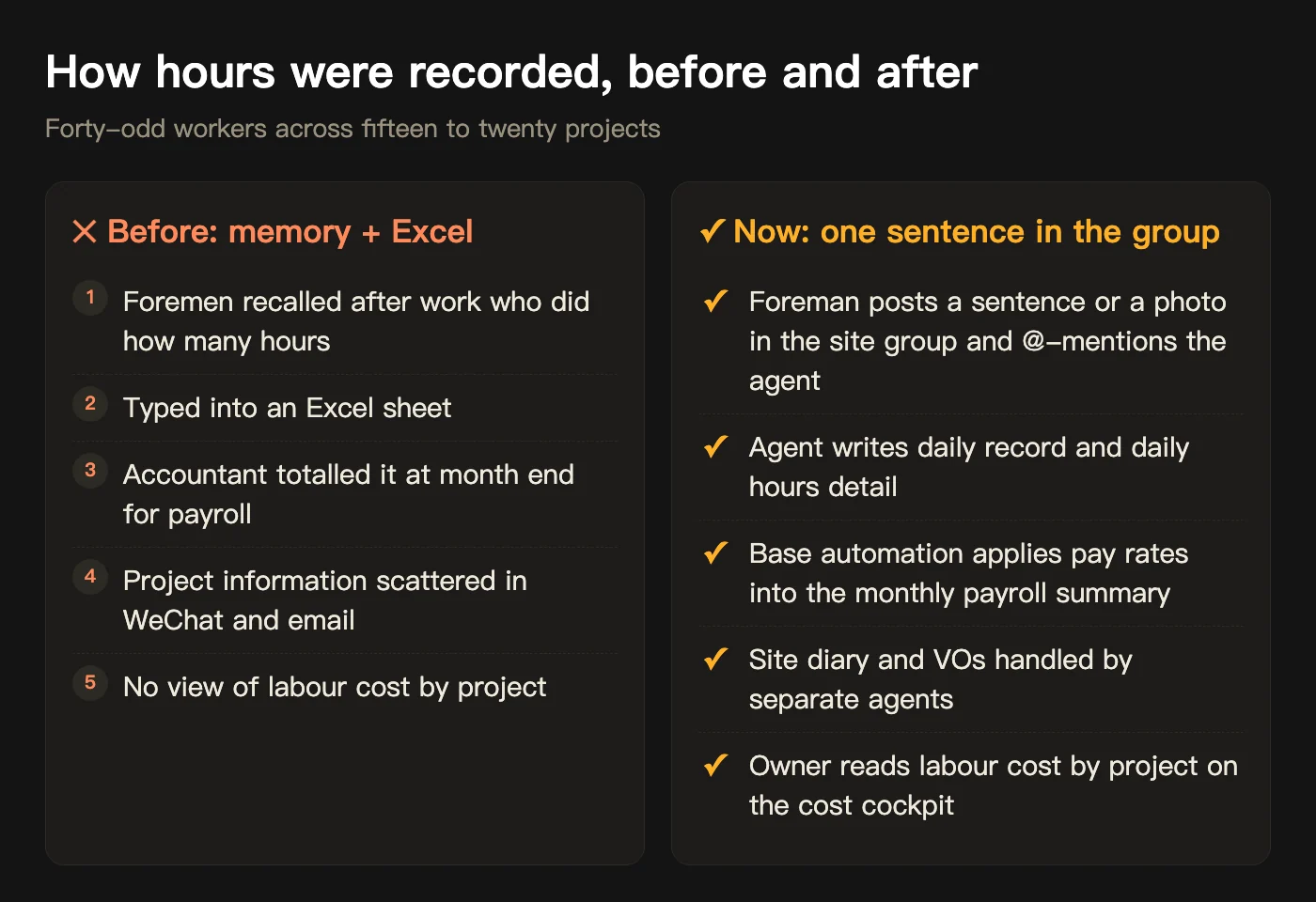
Lever three: cross-system reconciliation, the workflow that went live in 11 days
A financial training firm reconciled sales by exporting payment records and sales records from two systems and comparing them line by line. The project started on 20 July 2026 and went live on 31 July, 11 days. The agent pulls both sets of records on a fixed schedule, matches them by rule, lists every difference and tags the likely cause; people read only the difference list and decide what to chase or correct. It is the fastest go-live in our records for one reason: the data was already in two systems, the rule fitted in a sentence, and no new data entry was added. Reconciliation, chasing and reminder workflows are usually planned as a two-to-four-week pilot; 11 days is the best case on record, not a promise.
Lever four: customer orders, from a WeChat group to a courier label
A New Zealand cross-border health-products retailer had a salesperson copy WeChat-group orders into a master sheet and then into an import template for SF Express. Kickoff was 4 June 2026, the first production order shipped on 2 September and the label callback was working on 9 September, about 90 days. Now the agent reads the order text, splits it, maps SKUs and issues a verification card; only after a person checks recipient, product, payment and ID and says ‘review passed’ does the agent call the SF Express API, and the label comes back by callback and is archived. Development was less than half of the 90 days; the rest went on WeChat account access, SF production parameters and confirming the label mechanism. Workflows that connect to external platforms should be planned by the quarter.
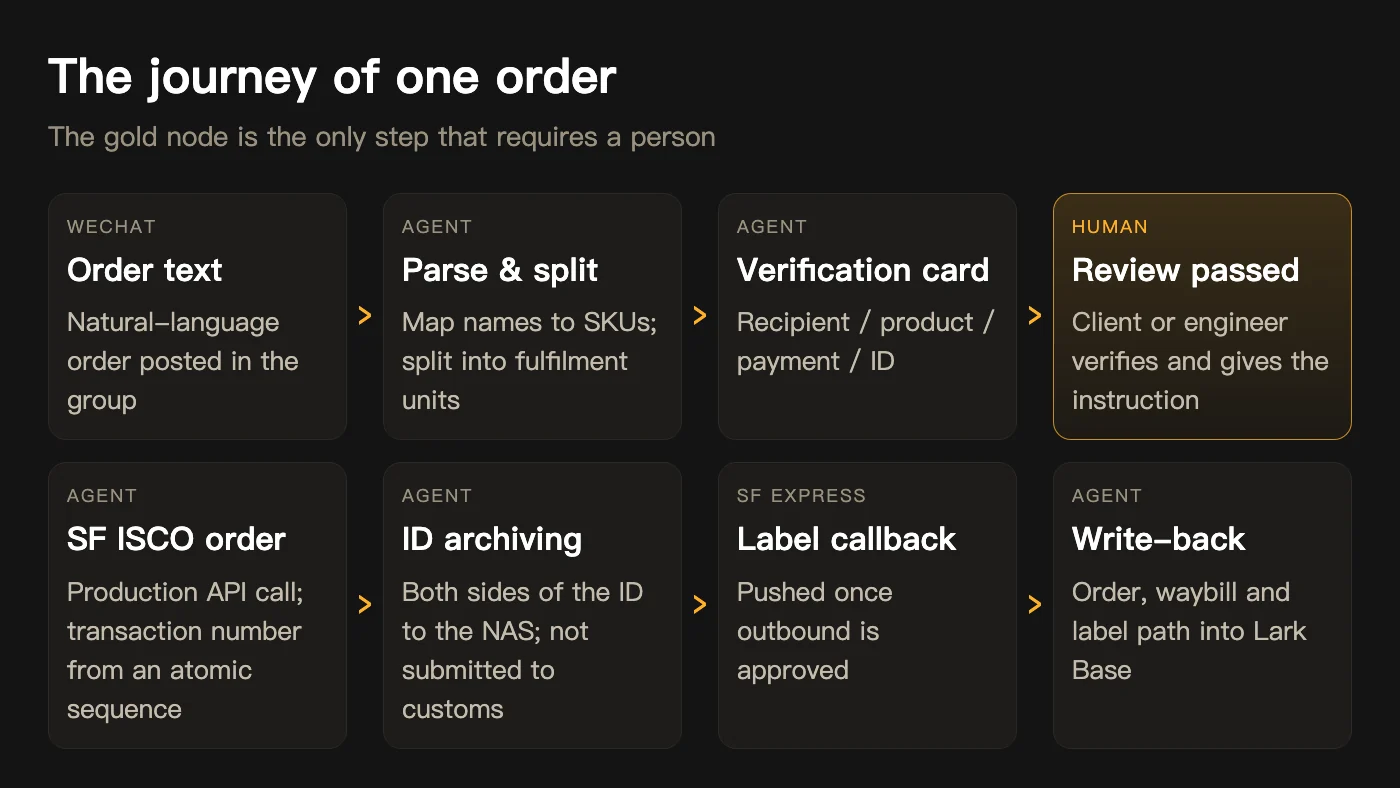
Lever five: market reach, how a business improves its market reach rate
The first four levers cut cost; the fifth looks for revenue. The AI approach to improving market reach is to have agents watch market signals continuously and chain the actions: a market radar monitors competitor price changes, tenders and industry news, a hit triggers a content draft, leads are scored and qualified ones are handed to sales, all inside the Lark or Teams the company already uses. BEE Sigma currently publishes this lever as an interactive demo (GTM episode 1, ‘A lead pipeline’); the visibility score moving from 32 to 71 in that demo is demo data, not a client delivery record. Every outbound message and every commitment is still confirmed by a person.
Scope note: figures for levers one to four come from dated project review records with client names removed; lever five is a demo scenario. Durations are observed, not a promise to other businesses.
How a business optimises its workflows: four steps and one rule
Put the five levers back into method and workflow optimisation is four steps. One, measure the baseline: how many person-hours, errors and waits this process costs per month; without a baseline there is no ‘improvement’. Two, choose one workflow using the four traits above. Three, run a two-to-four-week pilot with acceptance criteria written down before work starts. Four, scale only after the pilot passes, adding approval points and permissions as you go. One rule runs through all of it: payment, pay-rate changes, external commitments and contract signatures are confirmed by people. The AI prepares, checks and reminds; a person presses the final button. To find out which workflow your business should start with, take the free AIM assessment.
- Measure the baseline: person-hours, error rate, waiting time, over the last full month.
- Pick one workflow: frequent, clear rules, data already present, errors caught by a person.
- Short pilot: two to four weeks, acceptance criteria fixed before kickoff.
- Then scale: add approval points, separated permissions and a rollback plan.
Primary sources
Case study: three months to 91% invoice automation ↗Case study: site timesheets from Excel to a chat group ↗Case study: from WeChat orders to SF Express labels ↗New Zealand AI Strategy & business guidance (MBIE) ↗How do businesses use AI to improve efficiency, and which workflow shows results fastest?
How does a business optimise its workflows, and does it need to replace its systems first?
How can a business improve its market reach rate, and what part can AI do?
How long does it take for AI to improve efficiency?
Which actions must stay with people in an AI efficiency project?
Best AI Consultants and AI Implementation Partners in New Zealand (September 2026): 17 Firms Compared
Which AI consulting and AI implementation companies operate in New Zealand? This review compares 17 firms from their public websites, in three tiers: enterprise integrators, boutique implementation studios and bilingual hands-on teams. It lists positioning, published NZD prices, city and best-fit company size, plus five selection criteria. BEE Sigma is included and labelled as a self-description.
Read articleAI Solution Pricing in New Zealand: How Much Does an AI Digital Employee Cost? 2026 Public Price Ranges and How to Read a Quote
Public prices for an AI digital employee (a business AI agent) in New Zealand run from a NZD 150-a-month subscription bot to a NZD 90,000 multi-system project. This article lists the prices New Zealand vendors published in 2026, with source and date for each, explains the five cost items behind the gap, and gives six things to check on any quote. Includes the MBIE 50% subsidy maths.
Read article