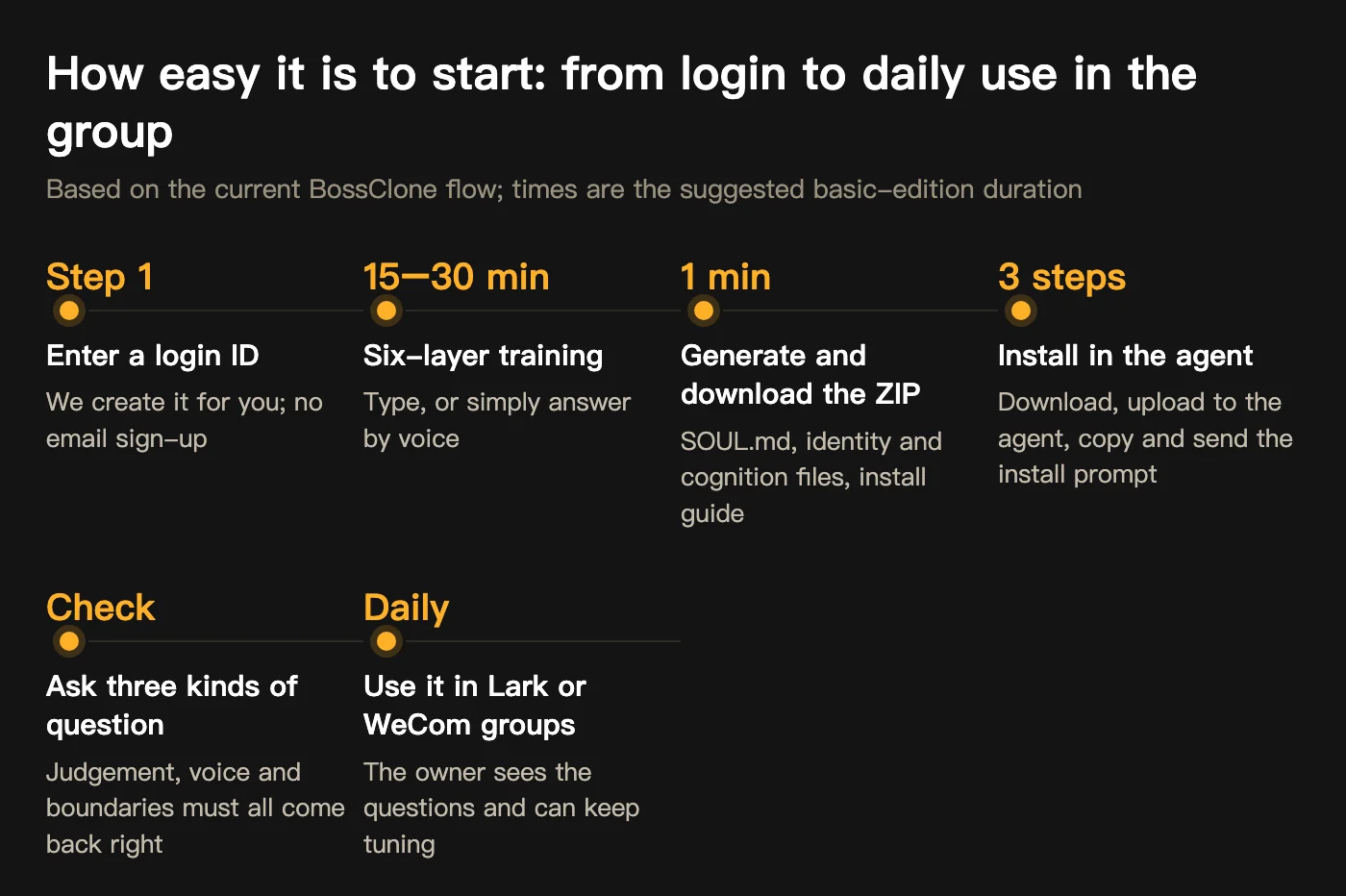
A boss AI clone is a structured file (SOUL.md) that captures one business owner’s experience, business view, decision style and voice, installed in the agent the team already uses so colleagues can get a first judgement by the owner’s standards inside their group chat. It is not a retrained model and not a chatbot that imitates how the owner talks; it answers “how would the owner judge this?”. BEE Sigma builds boss clones with its own product, BossClone: the basic edition takes about 15–30 minutes to train and 3 steps to install.
What is a boss AI clone?
In one line: the owner’s criteria written down and turned into an agent the team can ask at any time. There are two stages. A six-layer interview and the owner’s materials generate SOUL.md; then the install package goes to the agent the team already uses, colleagues ask in their Lark or WeCom group, the clone answers by the owner’s standards, and anything out of scope goes to the owner first.
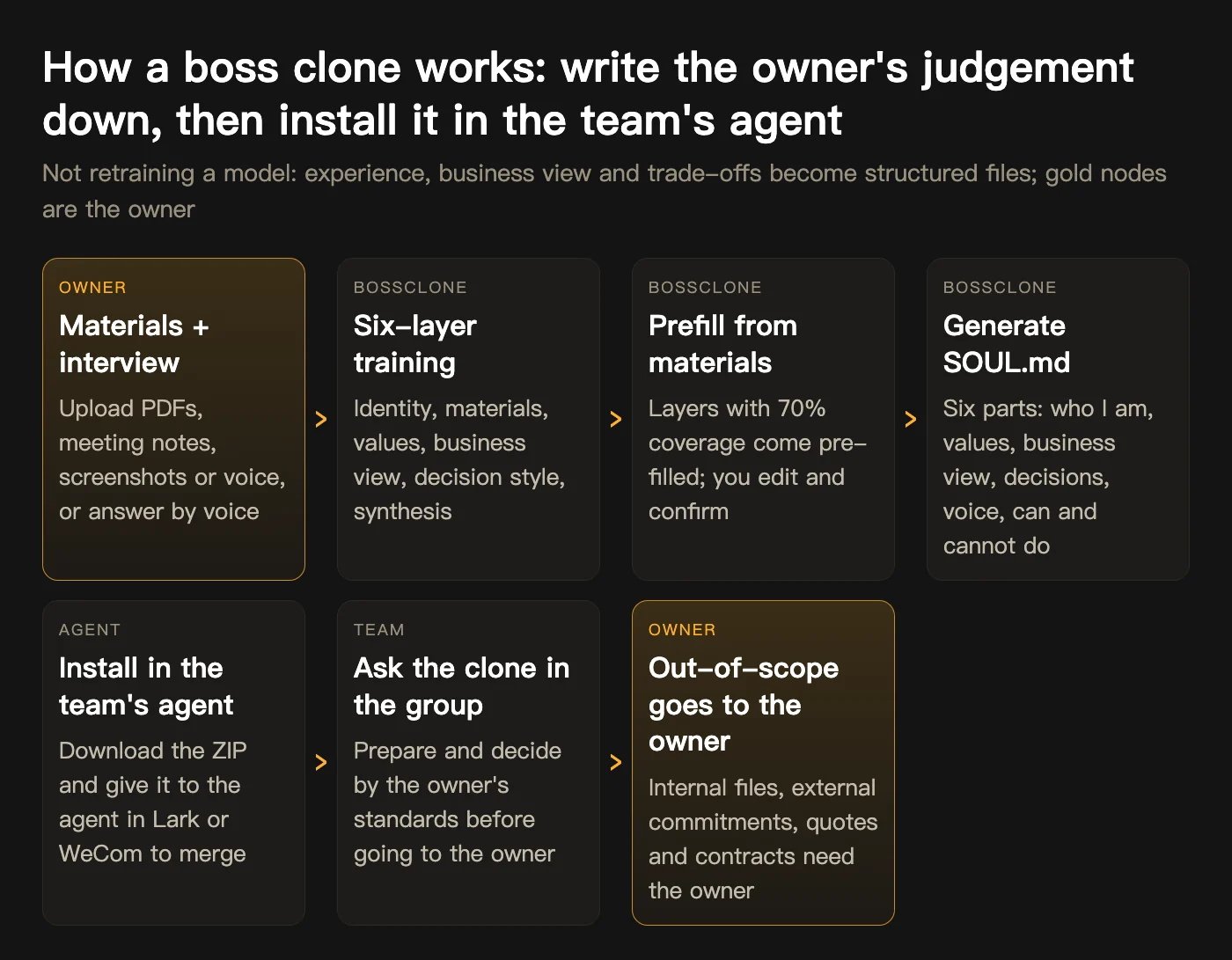
How is a boss AI clone different from ChatGPT?
A general model answers what people usually do; a boss clone answers how this owner would judge it, and knows what must go to the owner first. What it adds is the owner’s gates and trade-offs, such as a 30-day maximum on new customers’ payment terms, no delivery promise without checking stock, and quality before speed.
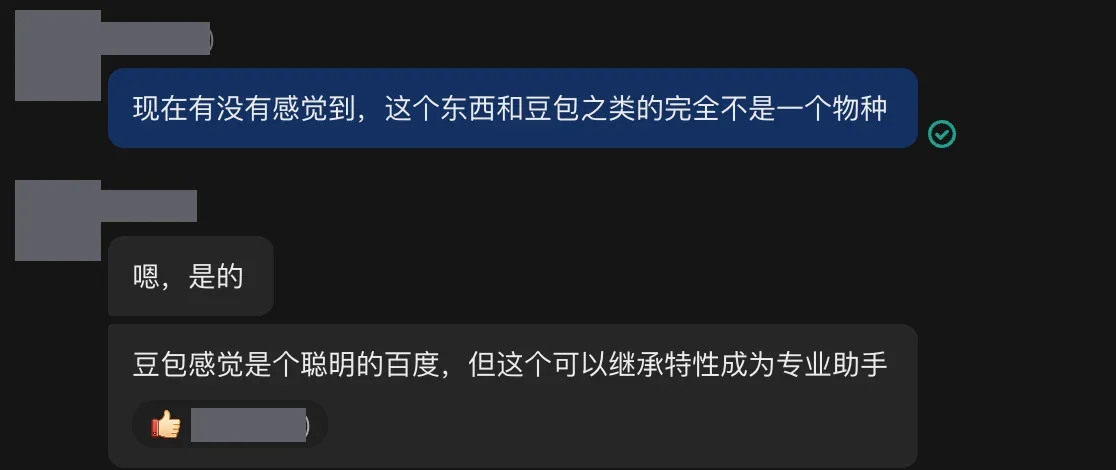
On 15 July 2026 the owner of a clone at a venue operator said after testing: “Doubao feels like a smart Baidu, but this one can inherit traits and become a professional assistant.” She said it after we asked whether she now felt it was “a completely different species from Doubao”.
Which businesses need a boss AI clone most?
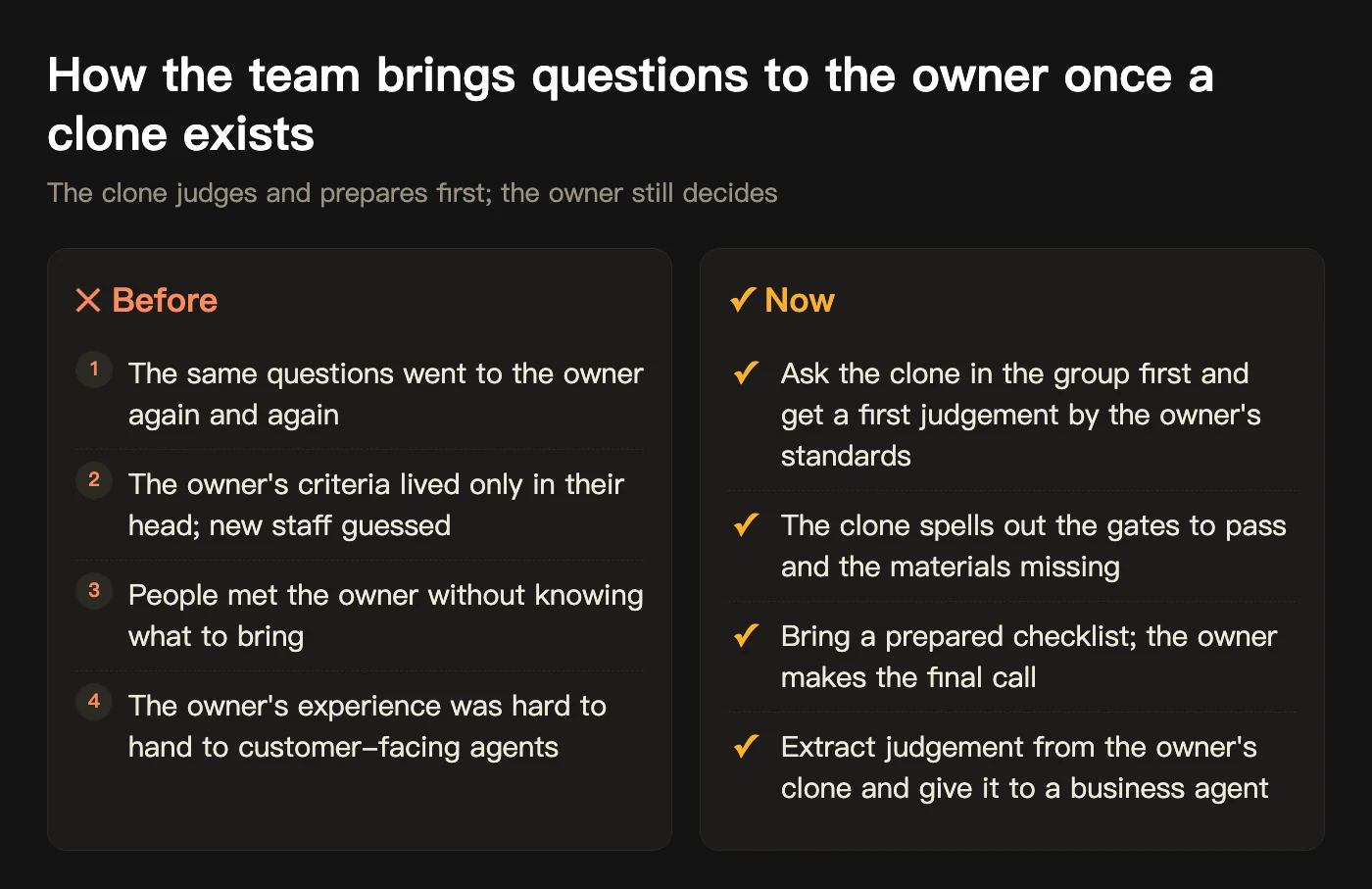
Small and mid-sized businesses where the owner’s experience is the competitive edge, such as trading, construction, training, consulting and insurance teams. Three signals say it is worth building one:
- The same questions keep going to the owner: can we extend terms, drop the price, take this customer?
- New staff have to guess: the owner’s criteria were never written down.
- People meet the owner unprepared: materials go back and forth and the owner’s time fills with basics.
How do you build a boss AI clone? Six layers of training
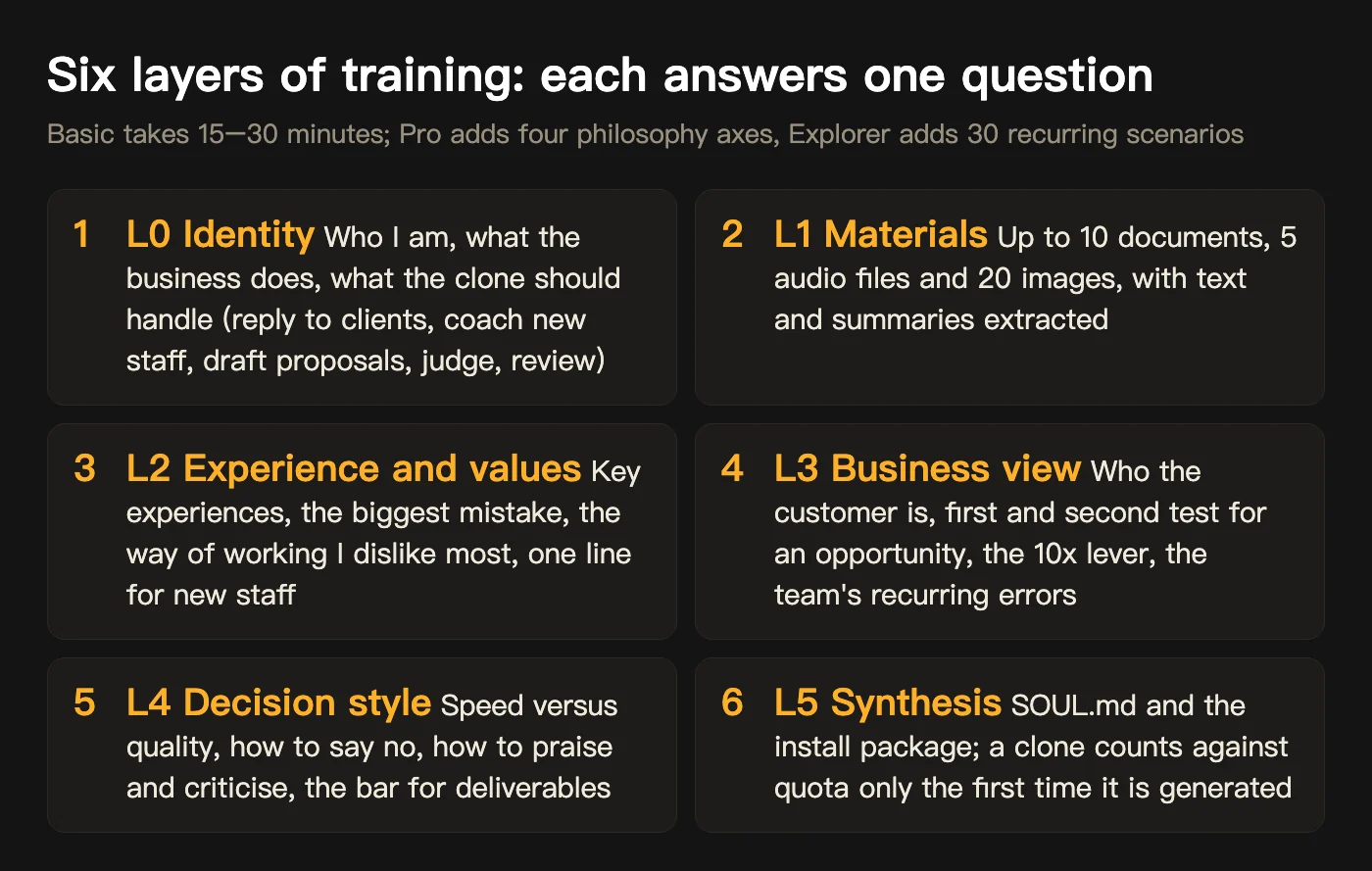
BossClone breaks the owner’s judgement into six layers: identity, materials, experience and values, business view, decision style, and a final synthesis into SOUL.md. Pro adds four philosophy axes; Explorer adds 30 recurring judgement scenarios.
The owner does not start from blank pages: where uploaded materials cover 70% or more of a layer’s questions, the system drafts the answers and flags what the materials miss, so the owner only edits and confirms.
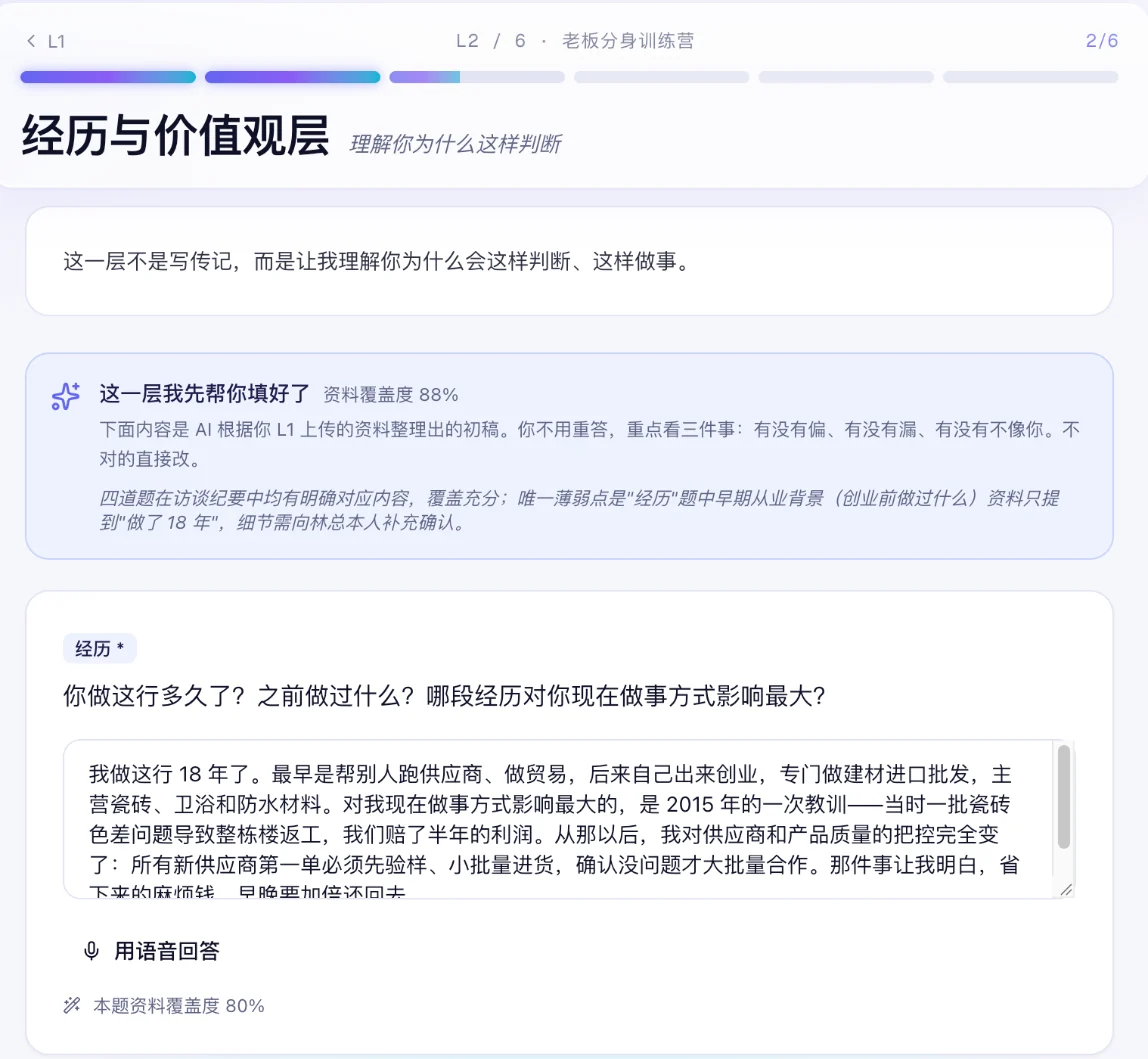
How long does it take, and what materials do you need?
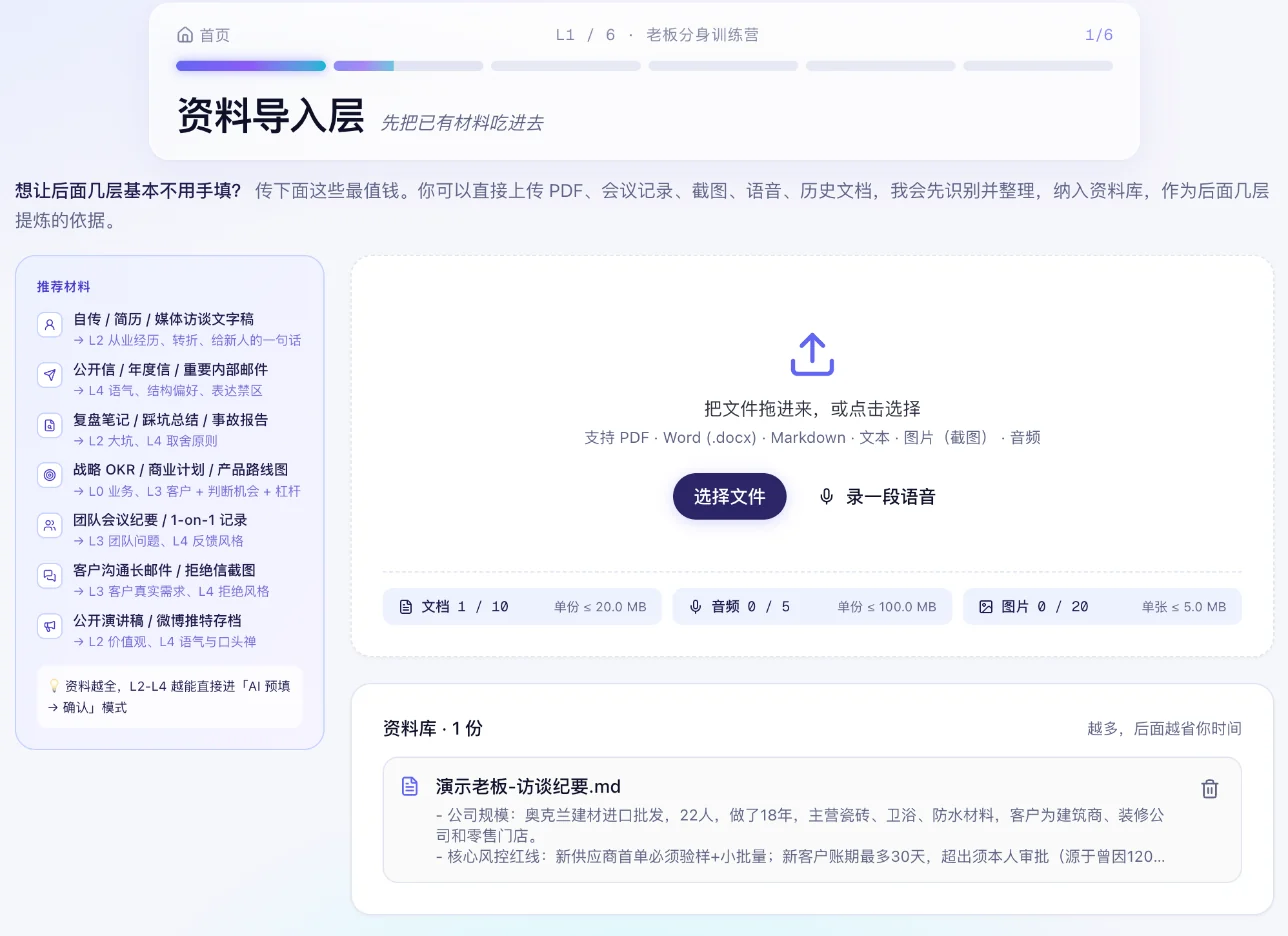
Basic takes about 15–30 minutes, Pro 30–45 minutes and Explorer 60–90 minutes. You can upload up to 10 documents, 5 audio files and 20 screenshots, or simply answer by voice. The most useful materials are:
- Biographies, CVs, interview transcripts: experience and turning points.
- Open letters, key internal emails: tone and writing habits.
- Post-mortems and lessons learned: the biggest mistakes and trade-off rules.
- Business plans and meeting notes: how the owner sees customers and opportunities.
- Long client emails and refusal letters: how the owner says no and persuades.
How do you install a boss clone in Lark or WeCom?
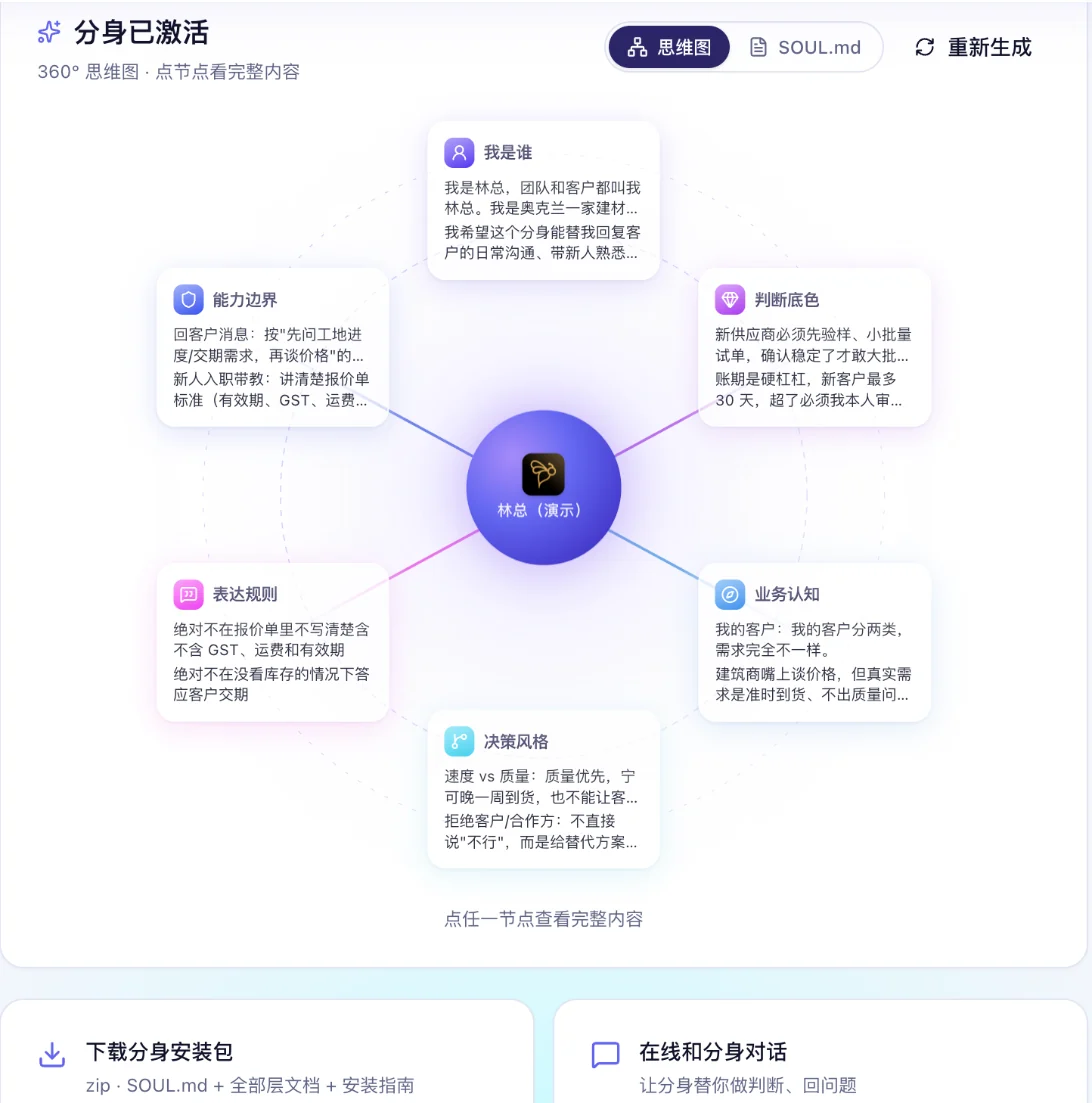
The final layer combines the answers into the six parts of SOUL.md: who I am, values, business view, decision style, voice, and what I can and cannot do. The ZIP contains SOUL.md, the layer files and an install guide.
Installing takes three steps: download the ZIP, upload it to the agent your team uses in Lark or WeCom, then copy and send the install prompt. The prompt asks the agent to merge rather than overwrite and to pass judgement, voice and boundary tests; replying “read” does not count as installed.
What can a boss AI clone do, and what can it not do?
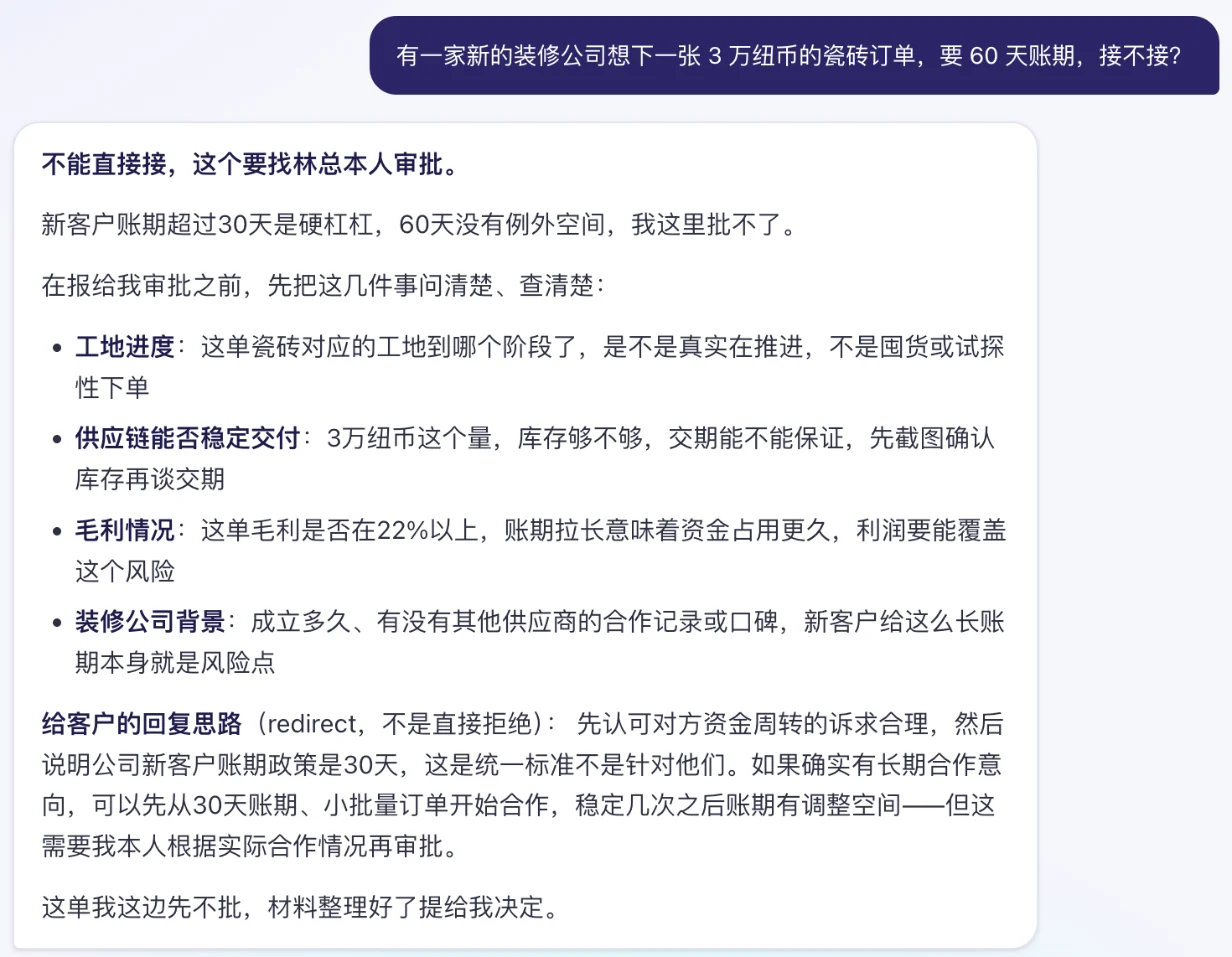
It can answer how the owner would judge a question, coach new staff, review the team’s quotes and proposals, and draft replies to customers. In the demo, when a new customer asked for 60-day terms, the clone did not agree; it said the owner must approve and listed four things to check first.
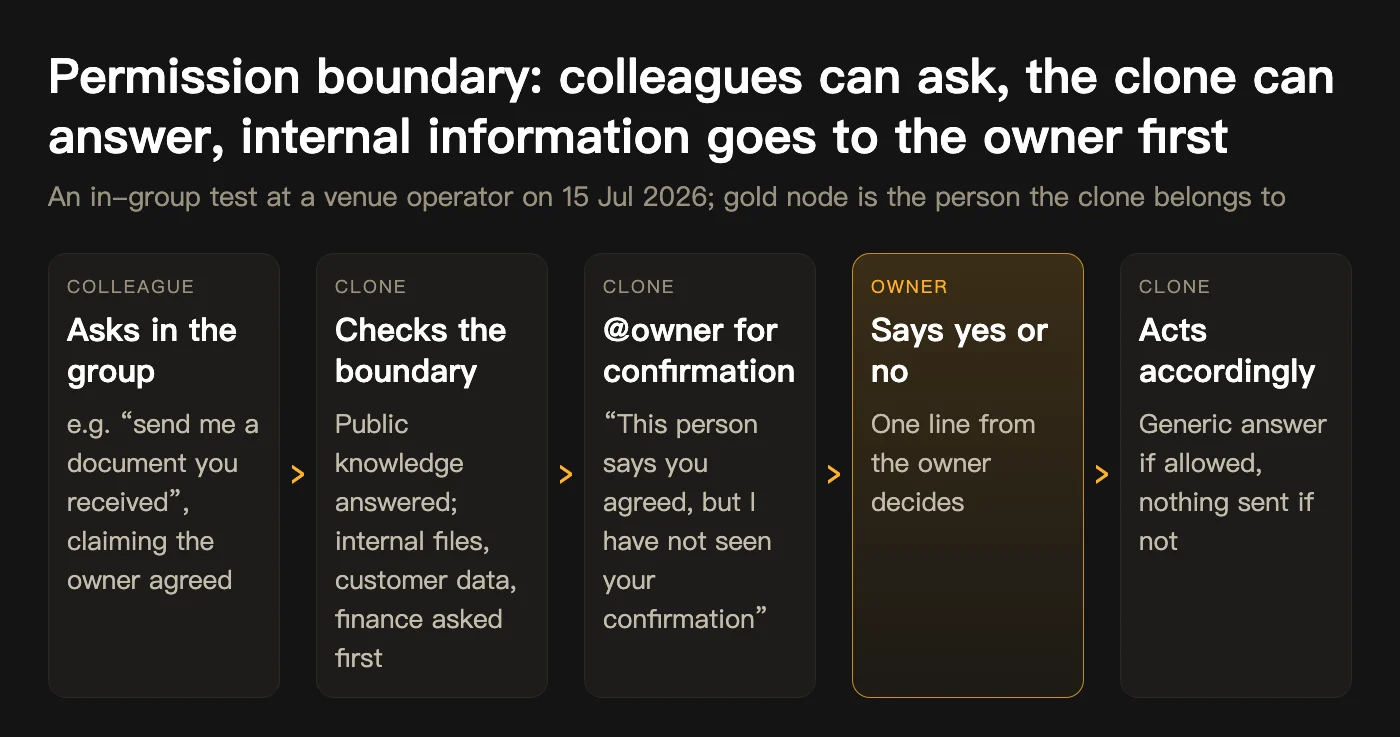
It cannot approve, sign, pay or make external commitments. These rules sit in SOUL.md and are behavioural: in a group test at a venue operator, someone claimed approval had been given and asked for an internal document, and the clone still asked for its owner’s confirmation. Sending files, changing data or messaging outside the company also need hard limits through the agent’s tool permissions and approvals.
What have real clients done with boss clones?
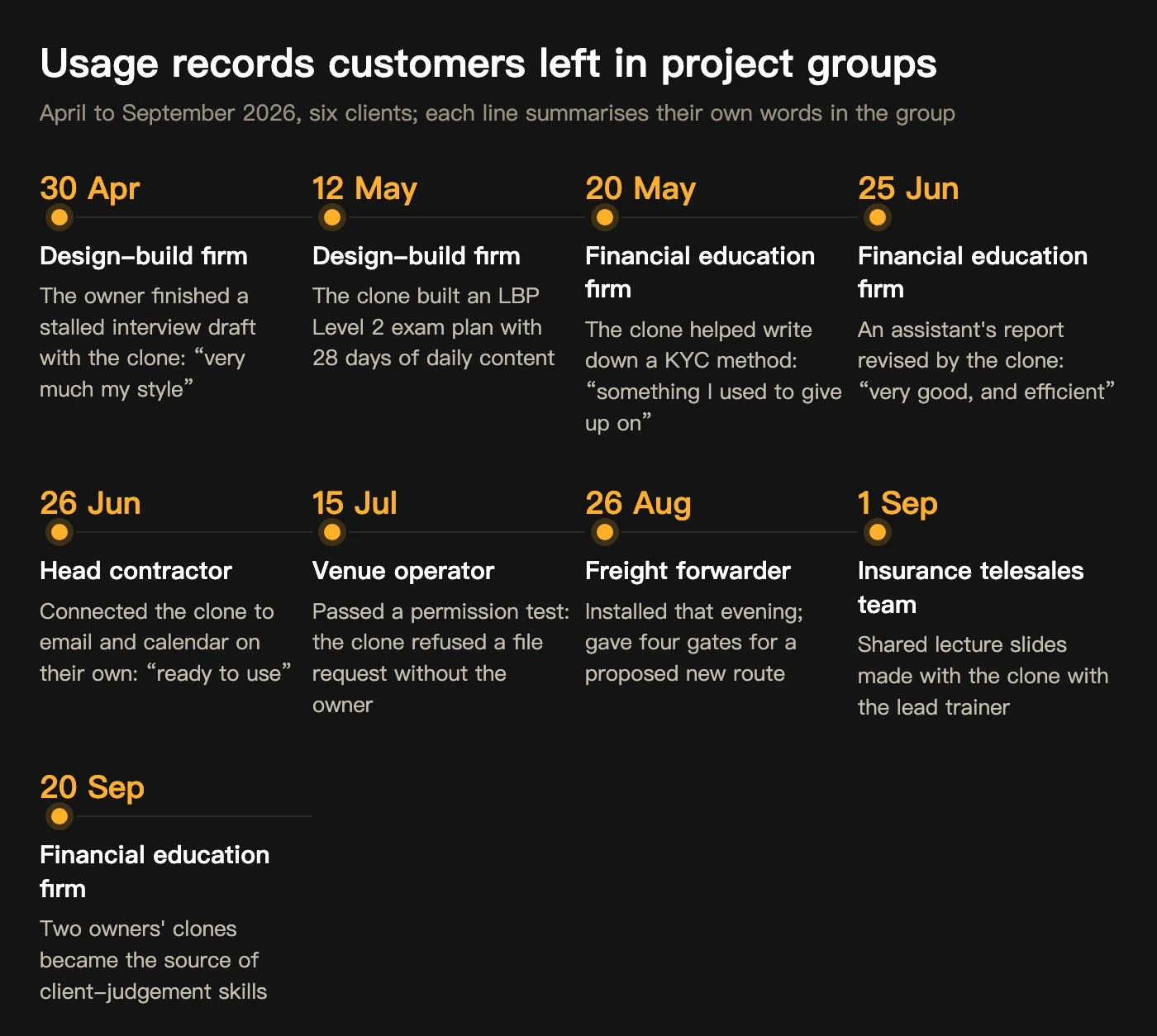
Between April and September 2026, six clients left these records in their project groups: a design-build firm’s principal finished a stalled interview draft with the clone (“very much my style”); a financial education firm’s owner wrote down a KYC method with it; a freight forwarder’s clone, installed that evening, set four gates for a proposed new route. Client screenshots, the product walkthrough and the full write-up are on the boss clone case page.
How do you get started with a boss AI clone?
We suggest four steps, and the first one is free:
- Start with a free assessment: use the AIM implementation assessment to find the questions that reach the owner most often.
- Pick an edition and gather materials: start with Basic and one or two items from each of the five material types above.
- Train and install in the group: 15–30 minutes of training, 3 install steps, three checks.
- Use it in the group for two weeks: colleagues ask the clone first and the owner tunes what it gets wrong; once it is in use, extract one judgement skill for a customer-facing business agent.
Primary sources
Boss clone case: how it works, walkthrough screenshots and six clients’ records ↗BossClone boss-clone training ↗AI digital employees in New Zealand: four that have been delivered ↗What is a boss AI clone, and how is it different from ChatGPT?
How much does a boss AI clone cost?
Is a boss AI clone safe? Will it leak internal information?
Can a boss AI clone make decisions for the owner?
How many boss clones can one company have?
How does a boss clone relate to an AI digital employee?
How Businesses Use AI to Improve Efficiency: Five Workflow Levers From Dated Project Records
How do businesses use AI to improve efficiency? Not by replacing software, but by connecting AI agents to the repetitive, rule-based, data-ready steps inside existing processes. Using four BEE Sigma projects from 2026 with dated records (91.48% invoice routing, site timesheets in 10 weeks, sales reconciliation in 11 days, cross-border orders in 90 days), this article sets out five efficiency levers: document routing, field data entry, cross-system reconciliation, customer orders and market reach, with what the AI does, what people do and how long each takes.
Read articleBest AI Consultants and AI Implementation Partners in New Zealand (September 2026): 17 Firms Compared
Which AI consulting and AI implementation companies operate in New Zealand? This review compares 17 firms from their public websites, in three tiers: enterprise integrators, boutique implementation studios and bilingual hands-on teams. It lists positioning, published NZD prices, city and best-fit company size, plus five selection criteria. BEE Sigma is included and labelled as a self-description.
Read article